
When Patient Data Stays Put, Care Suffers: The Case for Healthcare Interoperability
3 Sep 2026
Canada does not have a healthcare digitization problem anymore. It has a connectivity problem.
Electronic medical records, hospital information systems, pharmacy platforms and patient portals are now common across the country. According to the 2025 Survey on the Use of Digital Technologies by Health Care Providers, released by Statistics Canada in March 2026, 92% of Canadian healthcare providers had access to a digital health system.
Yet access to digital technology does not automatically create connected care.
Only 52% of providers reported using a digital system to share patient clinical information with healthcare providers outside their main practice setting. Nearly four out of five providers, or 78%, experienced at least one barrier that limited or prevented electronic information sharing.
The most frequently reported barrier was insufficient integration between different digital health systems, identified by 50% of providers with access to a digital system.
In other words, Canada has made significant progress in digitizing healthcare records, but too much information remains trapped inside systems that cannot communicate effectively with one another.
For healthcare providers in Ontario and across Canada, interoperability is not simply an information technology concern. It affects clinical decision making, patient safety, administrative workload and continuity of care every day.
Healthcare interoperability is the ability of different digital systems to exchange, understand and use health information securely.
True interoperability means more than exporting a document or sending a scanned report. It allows meaningful clinical information, such as allergies, medications, diagnoses, immunizations, referrals and test results, to move between authorized systems in a consistent format.
Consider a patient who visits a family physician, completes laboratory tests, receives treatment at a hospital and later sees a specialist. Each organization may use a different system. If those systems are interoperable, relevant information can follow the patient through the care journey.
If they are not, providers may need to rely on faxes, telephone calls, manually entered data, incomplete summaries or the patient’s recollection.
That gap can result in duplicated tests, delayed treatment, avoidable administrative work and decisions made without a complete clinical picture.
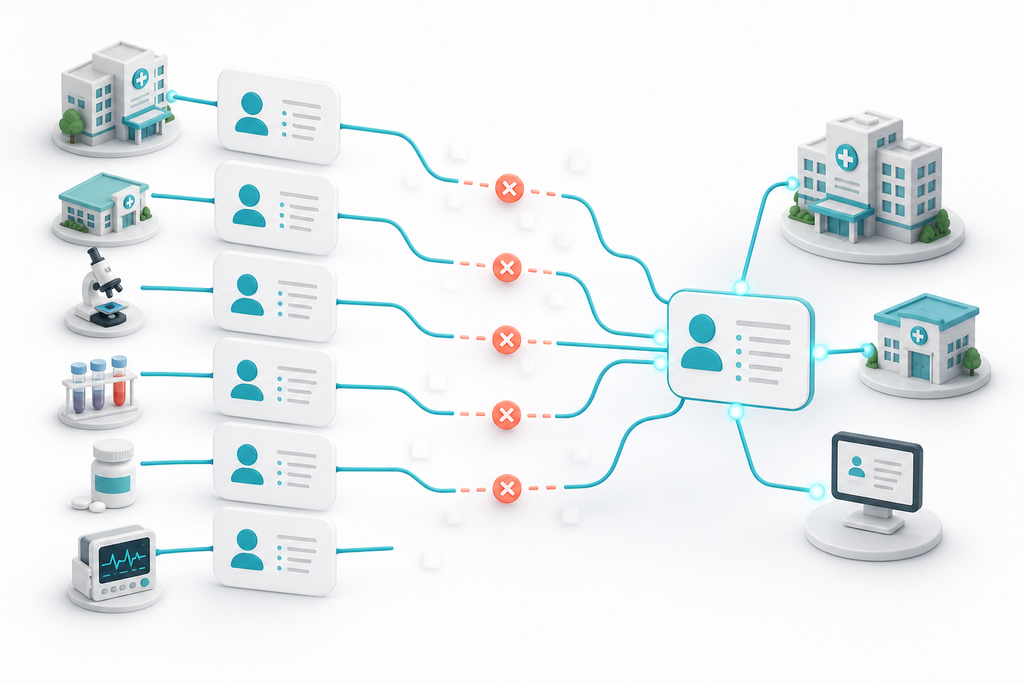
The Statistics Canada findings reveal an important distinction between having digital information and being able to use it across the continuum of care.
The survey collected responses during 2025 about providers’ experiences in 2024. It found that access to digital health systems was high in every province. However, the extent to which providers used those systems to share information varied substantially.
Across Canada:
The findings also showed that providers in rural and remote areas experienced barriers at a higher rate than those in urban areas. This is especially significant because connected information can be vital when patients must travel between communities or receive care from multiple locations.
The numbers point to a clear conclusion: digitization without interoperability leaves much of the value of digital healthcare unrealized.
When healthcare information does not follow the patient, the burden of filling the gaps often falls on patients and frontline providers.
Patients may be asked to repeat their medical histories at every new care setting. They may not remember the exact name or dosage of a medication, the date of a procedure or the details of a previous diagnosis. Providers may spend valuable time requesting records or repeating investigations because earlier results are not readily available.
The Canadian Medical Association’s explanation of the Connected Care for Canadians Act highlights the risks of fragmented information, including delayed or duplicated testing, a greater possibility of errors and difficulty coordinating care.
The consequences can be particularly serious during:
Interoperability gives providers a more complete and timely view of the patient. It supports safer prescribing, better informed decisions and more coordinated follow up.
It can also reduce the frustration patients experience when they know their information exists somewhere but cannot be accessed by the person currently responsible for their care.
Canada’s interoperability landscape is beginning to change through a combination of legislation, common data standards and trust frameworks.
The federal government introduced Bill S-5, the Connected Care for Canadians Act, on February 4, 2026. This followed an earlier version of the proposed legislation introduced in 2024.
Bill S-5 is intended to require health information technology vendors to ensure that the systems they license, sell or supply as a service are interoperable. It would also prohibit data blocking, which includes practices that prevent, discourage or interfere with access to, use of or exchange of electronic health information.
This could address situations in which healthcare organizations encounter excessive costs, delays, technical restrictions or unusable data when trying to integrate another service, migrate to a new platform or retrieve their records.
The proposed legislation does not create a single national health database. Its purpose is to establish conditions under which different systems can exchange information securely and consistently, while existing privacy requirements continue to apply.
As of August 2026, Bill S-5 had passed the Senate and was at second reading in the House of Commons. Healthcare providers should therefore view its requirements as an important direction of travel, while recognizing that the bill was still moving through the parliamentary process.
Systems cannot exchange useful information unless they share a common understanding of the data being transferred.
The Canadian Institute for Health Information has released Version 2 of the Canadian Core Data for Interoperability, commonly known as CACDI. It defines a core set of standardized health data elements and value sets designed to support information exchange across Canada’s healthcare systems.
Standards of this kind help ensure that information recorded in one system can be correctly interpreted by another. Without them, two platforms may store similar information using different structures, terminology or codes.
CACDI contributes to a future in which health information can be collected once and used appropriately across multiple care settings, rather than being repeatedly re-entered or reformatted.
Interoperability must be supported by more than technical compatibility. Healthcare organizations also need confidence that information is being shared with the right people, for the right purposes and under appropriate legal, security and governance arrangements.
Canada Health Infoway’s Connected Care Trust Framework Blueprint, released in May 2026, outlines a national approach to trusted health data exchange.
Developed with input from federal, provincial, territorial and Indigenous partners, the blueprint addresses the governance, legal and technical foundations needed for information to be shared securely and at scale. It is designed as a federated approach, meaning that it does not replace existing systems or centralize all Canadian health data.
The initial blueprint remained in draft form while Infoway continued national engagement, with finalization planned for fall 2026.

For healthcare providers in Ontario, connected care has the potential to improve both clinical and operational workflows.
A more interoperable environment could make it easier to:
However, interoperability should not be treated as a future requirement that belongs only to governments and vendors. Practices can begin preparing now.
When assessing an EMR, practice management platform or new integration, providers should ask:
These questions can help practices distinguish between software that is merely digital and technology designed to participate in a connected healthcare ecosystem.
Canada is not alone in confronting fragmented healthcare information.
An ITWeb discussion of South Africa’s healthcare data gap captured the principle succinctly: when patients move through the healthcare system, their data should move with them.
That principle applies just as strongly in Ontario. A patient’s information should not become inaccessible because the patient crossed a hospital boundary, visited a specialist using another platform or moved to a different province.
International experiences also reinforce that interoperability requires a combination of standards, governance, trust, privacy safeguards and technology designed for connection.
The Canadian Institute for Health Information’s report on strengthening Canada’s health information systems notes that timely access to health information can support better decisions, help prevent medical errors, avoid unnecessary tests and improve follow up care.
These are not abstract technical benefits. They are practical improvements that can affect every consultation.
Canada has already invested heavily in moving healthcare information from paper into digital systems. The next challenge is ensuring that this information can move securely, accurately and meaningfully between the people and organizations involved in a patient’s care.
For healthcare practices, the question is no longer simply, “Do we have a digital system?”
The more important questions are: Can it connect? Can information move safely? Can another authorized provider understand and use that information when the patient needs care?
Patients do not experience healthcare as a collection of isolated databases. Their information should not be confined to one either.
This article is for informational purposes and does not constitute medical or legal advice.
Ready to start practicing better? Let’s talk! Book a demo with the GoodX team.
